How much does a vet cost in Spain in 2026 — and what pet insurance actually covers
A consultation starts at €20, cruciate ligament surgery runs to €2,500. Real prices in Spain, the honest maths on when insurance pays for itself, and what the 80/20 rule means.
Наталья
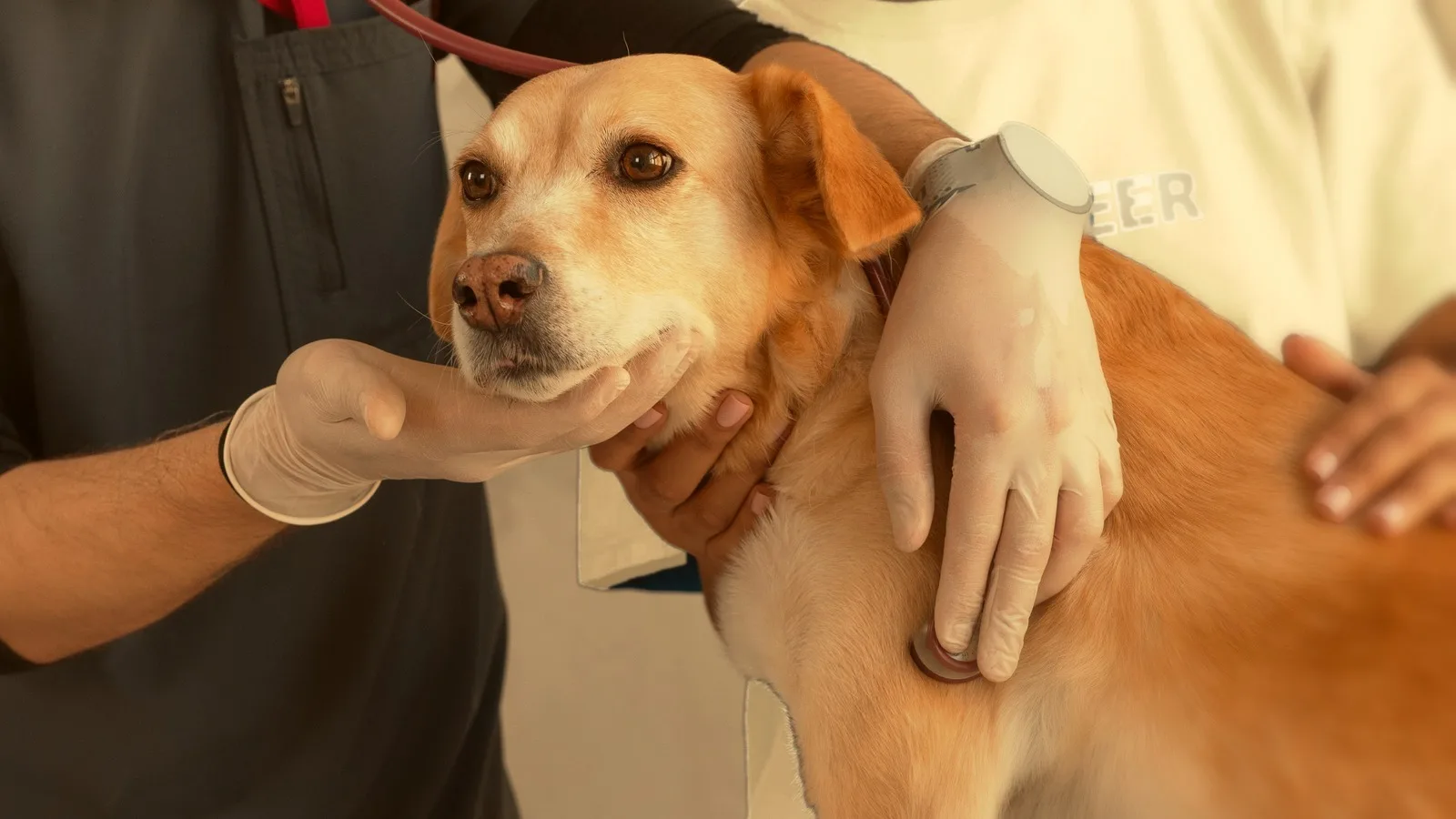
The short answer: a routine vet consultation in Spain costs €20–40, an emergency one €80–200, and surgery for a ruptured cruciate ligament runs from €800 to €2,500. Pet insurance typically reimburses 80 % of the bill — the remaining 20 % is yours. A policy makes sense not as a way to save on vaccinations, but as protection against the one expensive event that arrives without warning.
Below: the actual numbers, the arithmetic, and the things insurance advertising tends to leave out.
What a vet costs in Spain: 2026 prices
The spread is wide. Madrid and Barcelona cost more than smaller cities, and private clinics more than chains. Market benchmarks for 2026:
Service | Price |
|---|---|
Routine consultation | €20–40 |
Full examination | €30–60 |
Emergency consultation (urgencias) | €80–200 |
Vaccination, injection | €20–40 |
Full blood panel | €40–100 |
X-ray | €40–90 |
Abdominal ultrasound | €40–100 |
CT scan | €300–800 |
General anaesthesia | €80–200 |
Dental scaling | €80–200 |
Hospitalisation | €50–150 per day |
Neutering (male) | €100–300 |
Spaying (female) | €150–500 |
Tumour removal | €150–1,000 |
Keeping a healthy dog, with nothing going wrong, costs roughly €150–350 a year: the annual check-up, vaccinations, parasite treatment. Most people budget for this.
The trouble is that this is not the money that breaks the budget.
Three bills that break the budget
Ruptured cruciate ligament. The dog lands badly chasing a ball. Surgery is €800–2,500 depending on the animal's size and the technique, recovery takes 8–12 weeks, physiotherapy on top. X-rays, consultations and post-operative medication are extra.
Gastric torsion. A condition measured in hours, with surgery at €500–2,000. You cannot wait until morning, which means it is also an emergency consultation at out-of-hours rates.
Hip dysplasia. Triple pelvic osteotomy comes to €800–1,500; a full hip replacement €2,000–5,000 per joint. There are, of course, two joints. Recovery takes 6 to 18 weeks.
Add the reality of emergency care: a serious case with diagnostics and hospitalisation is €500–1,500, and emergency surgery with aftercare €1,000–3,000 or more.
And one thing specific to Spain: leishmaniasis. Carried by sandflies, widespread across much of the country, treatable — but usually for life. That is not a one-off bill; it is a permanent line in the budget.
What insurance actually covers: the 80/20 rule
This is the thing worth understanding before you start comparing prices.
"Covers surgery" almost never means "covers it in full". The standard arrangement on the Spanish market is reimbursement of 80 % of the bill. The remaining 20 % is the excess, and you pay it.
In practice:
Event | Bill | Insurance pays | You pay |
|---|---|---|---|
Emergency consultation | €150 | €120 | €30 |
Cruciate ligament surgery | €2,000 | €1,600 | €400 |
Hip replacement | €3,500 | €2,800 | €700 |
When comparing policies, look at this percentage before you look at a three-euro difference in the monthly premium. It decides far more.
And the mechanics are always the same: you pay first, then submit documents, then receive the reimbursement. Insurance does not remove the need to have the money at the moment it is needed — it returns most of it afterwards.
Waiting periods: why you cannot buy a policy "when you need it"
This is the second thing people trip over. Between signing and real protection there is a gap — the waiting period, or carencia. And there is more than one.
Using the terms of Barkibu, the insurer we work with:
5 days — accidents;
28 days — illness;
6 months — hip and elbow dysplasia, cruciate ligament rupture, patellar luxation, epilepsy, herniated disc, leishmaniasis, cataracts, atopy and dermatitis, for animals aged six months or over;
no waiting period — preventive care.
Look at that six-month list again. These are precisely the diagnoses from the section above, the ones that cost thousands. The whole market works this way, and it is not a trick: otherwise policies would be bought on the day of diagnosis.
The practical conclusion is simple and unwelcome: take out insurance while the dog is healthy. A policy bought on the day the animal starts limping will not cover that limp.
What is never covered
Waiting periods end. These exclusions do not:
Pre-existing conditions. A diagnosis is not required: symptoms before the contract, or during the waiting period, are enough. This is why the full medical history is requested with the first claim.
Brachycephalic syndrome — breathing problems in pugs, French bulldogs and other flat-faced breeds.
Congenital heart defects.
Cosmetic procedures, dental implants and orthodontics.
Genetic testing.
Obesity.
Supplements and antiparasitics without a prescription.
Travel costs.
Note that insurers draw these lines differently. Some classify dysplasia as congenital and do not cover it at all; others cover it after a six-month wait. If your breed is in a risk group — German shepherd, labrador, golden retriever, rottweiler — this is the first thing to check in the terms.
📄 We went through the policy terms line by line and put together a guide — what the policy covers, how to file a claim and ten questions worth asking before you sign. [Download free →]
The maths: when insurance pays for itself
The honest arithmetic, without which the conversation is pointless.
The cost. A real quote for a cat came to €26.91/month with a €3,000 annual cap and €32.98/month unlimited. For a dog the price depends on breed, age and size, and is usually higher. Take €27/month as an example — that is €324 a year.
A quiet year. Routine spending is €150–350. Preventive care is reimbursed at 80 %, but capped at around €100 a year. So in a year with nothing wrong you are almost certainly out of pocket. That is normal and it is not a swindle — all insurance works this way.
One serious event. Ligament surgery at €1,800 returns €1,440 to you. That is four and a half years of premiums recovered in a single evening.
The conclusion. Pet insurance is not a way to save on routine care. It is protection against one unlikely but ruinous event. The question worth answering honestly: do you have €2,000 free today in case the dog starts limping tomorrow? If yes, you can skip the policy and save the money yourself. If not, the policy is how you avoid choosing between treatment and money.
Is pet insurance mandatory in Spain?
Short answer: health insurance, no. Civil liability, depends on the dog.
There is a lot of confusion here, because these are two different products.
Veterinary expenses insurance — the subject of this article — is voluntary. No law requires it.
Civil liability insurance covers damage your dog causes to third parties. Animal welfare law 7/2023 mentions this obligation for dog owners, but at the time of writing it is awaiting implementing regulations and does not apply generally. The official joint note from Spain's insurance regulator states it plainly: the requirement does not take effect until the regulation is in place.
The exception, in force for years. For dogs classed as potentially dangerous (PPP), civil liability cover of at least €120,000 is mandatory — along with a municipal licence, a certificate of physical and psychological fitness, and a muzzle in public. The Spanish list includes the pit bull terrier, Staffordshire bull terrier, American Staffordshire terrier, rottweiler, dogo argentino, fila brasileiro, tosa inu and akita inu, plus dogs with pronounced musculature weighing over 20 kg.
And one practical tip that saves money: check your home insurance policy first. Many Spanish policies already include liability for damage caused by pets, so a separate one may be unnecessary.
The bill nobody plans for: who stays with your animal
There is one cost that appears on no list of veterinary prices, and that everybody eventually meets: what to do with the animal when you travel.
If you moved to Spain recently, this bites harder. At home there was someone — a neighbour, your parents, a friend with keys. Here, for the first months, there is nobody, and the first work trip or family emergency arrives sooner than you build a circle of your own.
And there is a detail here connected to insurance. The policy protects the animal, not the person holding the lead — an incident while your dog is with a sitter is covered on the usual terms. But for the claim to go through you need three things:
Whoever has the animal has your contact details and the policy information.
They know to collect the original invoice and a written report with the diagnosis at the clinic — without those there is no reimbursement.
Documents are submitted within three months of payment. The window is short and easily missed.
Worth knowing separately: where the policy applies. It works in Spain and during temporary trips within the EU, the UK and Andorra — usually up to six months. Take your dog outside that zone and the insurance does not follow. Sometimes that is one more argument for leaving your pet at home with someone you trust rather than taking them along.
My Tails is a platform for finding a sitter in your area: with a profile, reviews and clear terms. Boarding, care at your home, day visits or walks. You can see each sitter's profile in advance and meet before booking, rather than on the day you leave.
Frequently asked questions
How much is a vet consultation in Madrid?
A routine consultation is €20–40, and in the capital usually closer to the upper end. An emergency appointment outside working hours is €80–200.
Is it cheaper to insure or to save the money myself?
In a quiet year, saving wins. With one serious operation insurance wins outright: €1,440 reimbursed on an €1,800 procedure covers more than four years of premiums. It is a bet on a rare but ruinous event.
From what age can a dog be insured?
Usually from 8 weeks. The upper limit for a first policy is generally around 11 years. Once an animal is insured, renewal continues without an age cap.
Does insurance cover vaccinations and preventive care?
Often yes, but under a separate small allowance — typically 80 % reimbursement capped at around €100 a year, which does not consume the main limit. Preventive care usually has no waiting period.
What do I need in order to insure my pet?
A microchip and up-to-date vaccinations. For dogs: rabies, distemper, hepatitis, parvovirus. For cats: rabies, panleukopenia, herpesvirus, calicivirus.
How long does reimbursement take?
You pay for treatment first, then file the claim: original invoice, written veterinary report with the diagnosis, and the medical history on the first claim. The deadline is three months from the date of payment, and all documents must be in Spanish — worth knowing if you don't speak the language, because the clinic will usually issue them in Spanish anyway.
What to do
If your dog is healthy — settle the insurance question now, before the waiting periods start and while the age still allows it.
If your breed is in a risk group — read how your insurer treats dysplasia and congenital conditions. This is where companies differ most.
If your dog is on the potentially dangerous list — start not with health cover but with the municipal licence and €120,000 civil liability. That requirement is in force and it is enforced.
And in any case — decide in advance who will stay with your animal when you travel. That is the cost, and the problem, that always arrives unannounced.
This article is for general information and does not constitute insurance advice. My Tails does not sell insurance policies and takes no part in arranging them. Prices are market benchmarks as of October 2026 and vary by region and clinic; insurance terms are based on Barkibu's published conditions at the same date. Always read your own insurer's current terms before signing..